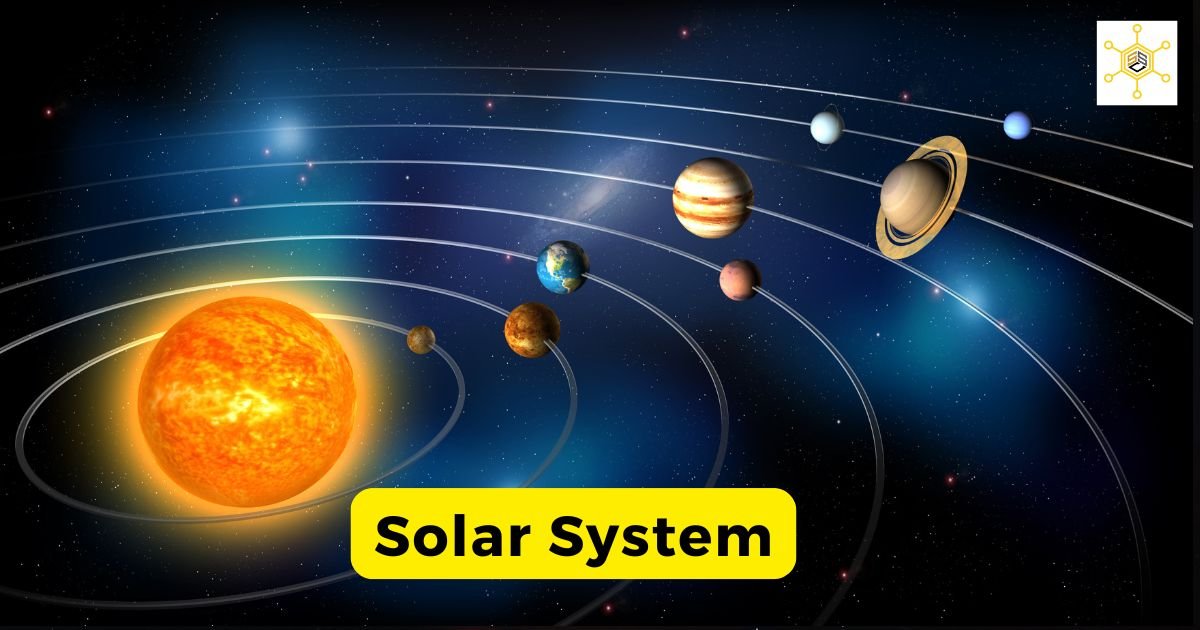
Often when you read the subject of geography, you get to know about Solar System, today we are going to tell you about all the things that will be useful in the upcoming exam, so definitely read them well. Questions are often asked from this topic concerned in the exam, so it is very important.
Solar System
• The eight planets including the Sun, Earth, their satellites and other celestial bodies are included in the Solar System.
• All the eight planets revolve around the Sun in a elliptical path in fixed orbits and rotate on their own axis.
• The solar system is located in a corner at a distance of about 30,000 to 33000 light years from the center of the galaxy and the Sun is located at its center. The Sun is the main source of light and energy for the entire solar family.
• Mercury, Venus, Earth and Mars are called inner planets, they are also called terrestrial planets. These four planets are made of rocks and metals like Earth and are smaller in size and have a relatively high density.
• The remaining four planets are called outer planets. These gas giant planets are also called Jovian planets. They have less density. Being like Jupiter, they are called Jovian planets.
• All the planets rotate from west to east but Venus and Uranus are exceptions. Their direction of rotation is from east to west (Clock-wise).
• According to NASA, Saturn has the most 82 satellites or moons, 79 of Jupiter, 27 of Uranus, 14 of Varuna, 2 of Mars, 1 of Earth and no satellites of Venus and Mercury.
Celestial Bodies
Milky Way Galaxy
• The galaxy in which the Earth is located is called Milky Way galaxy. Its shape is spiral. A group of many stars, dust particles and gases is called a galaxy. All these celestial bodies are bound to each other by the force of gravity.
Nebula
• A nebula is a highly luminous celestial body made up of gas and dust particles.
Constellation
• A group of stars is called a constellation. They have been named on the basis of their distinctive shapes. According to the IAU (International Astronomical Union) the number of constellations is considered to be 89. Most of the constellations are located on the southern hemisphere side.
Meteorite
• These are extremely fine cosmic particles made up of dust and gas and moving at high speed in the space. They enter the Earth’s atmosphere in the form of rocks due to the gravity of the Earth. Which are called ‘Meteorites’.
Comets
• It is a celestial body made of celestial dust, gas, ice etc. They revolve around the Sun. Halley is a famous comet (tail star), visible every 76 years.
Asteroid
• It is a small celestial body, which is situated between Mars and Jupiter. Their number is believed to be 45000. Four Vesta is the only asteroid that can be seen with the naked eye.
Meteors
• Meteors are solid celestial substances, which, upon entering the Earth’s atmosphere, burn due to its friction (gravity). They seem to break like stars in the night. These are called shooting stars or meteorites.
Asterism
• A group of stars in space is called a constellation. IAU has considered their number to be 27 but Indian astronomers and mystics have considered 28 constellations. Abhijit is envisaged as the 28th Nakshatra.
Pole star
• The star located above the North Pole of the Earth is called the Pole Star. In ancient times, travelers used to know the direction through this pole star.
Our Solar System
• Sun, planets, satellites, asteroids, meteors, comets, dust particles and gases are found in the solar system.
Members of the solar system
1. Sun
2. Planets
3. Satellite
4. Asteroids
5. Meteorites
6. Comet
7. Dust particles and balls
Sun
• It takes about 8 minutes and 20 seconds or about (500 seconds) for sunlight to reach the Earth.
• Gases on Sun :-
1. Hydrogen – 71%
2. Helium – 26.5%
3. Other Gases – 2.5%
The planets
• Those celestial bodies which revolve around the Sun in a fixed path and do not have any source of energy of their own, have a definite size and density, they are called planets.
1. Mercury
2. Venus
3. Earth
4. Mars
5. Jupiter
6. Saturn
7. Uranus
8. Neptune
• Size of Planets – (In Decreasing Order)
Jupiter > Saturn > Uranus > Neptune > Earth > Venus > Mars >Mercury
Mercury
• The closest planet to the Sun.
• Smallest planet.
• Revolution period 88 days.
• Shortest rotation time.
• No satellites.
• No atmosphere is found on Mercury.
Venus
• God of Beauty
• Located second from the Sun.
• The hottest planet (because 90-95% CO2 in its atmosphere).
• Brightest Planet
• Nearest Planet to Earth
• Venus is also called morning star and evening star.
The orbital period of Venus is 225 days but the rotation period of Venus is 243 days.
• The planet with the longest rotation period.
• Sunrise is from the west and there are no satellites.
• Venus is called the twin planet of the Earth. (due to the same size and density)
Earth
• Earth is the only planet in the solar system on which there is life.
• Earth is tilted on its axis by 23.5 degrees.
• Earth is slightly flattened near the poles, due to its shape is called the geoid.
• Earth’s rotation period is 23 hours 56 minutes 4 seconds, almost a full day.
• The time taken by the Earth to make one revolution around the Sun is called a solar year.
• The Moon is the only satellite of the Earth.
Mars
• Second smallest planet.
• Mars is also called the Red Planet. Due to excess of iron oxide.
• The orbital period of Mars is 687 days.
• The rotation period of Mars is almost equal to the rotation period of Earth.
Earth 23 hours 56 minutes
Mars 24 hrs. 37 mins
• Olympus Mons Volcano – The largest volcano in our solar system on Mars.
• Nix Olympia Mountain – is located on Mars, which is three times bigger than Mount Everest.
Jupiter
• Asteroids revolve between Mars and Jupiter.
• It is the largest planet.
• The period of revolution is about 12 years.
• The planet with the fastest rotation speed which is about 10 hours.
Saturn
• Saturn is the last planet that can be seen with the naked eye.
• Saturn is called a yellow colored planet.
• The second largest planet and the sixth place from the Sun.
• Time of revolution = 29.5 years.
• It is the second fastest rotating planet.
Uranus
• The planet Uranus was discovered in 1781 by the British astronomer William Herschel.
• The planet Uranus is the third largest planet and is situated at 7th position from the Sun.
• Five rings are found around Uranus.
• This planet rotates on its axis from east to west, hence Sunrise-west and sunset from east on this planet.
• This planet is also called recumbent planet because it is tilted about 90° on its axis.
• It has 27 satellites.
Neptune
• The planet Neptune was discovered in 1846 by the German astronomer John Gase.
• This is the outermost planet of our solar system.
• It is the coldest and longest planet in the solar system.
• The planet has the highest orbital period ie. 165 years.
• The planet has 14 satellites.
Pluto/Yama/Kubera
• Pluto is called the Greek sea god.
• Pluto was discovered in the year 1930 by an astronomer named Claudus Thombog.
• The IAU declared it as s dwarf planet in 2006, removing it from the planetary category.
IAU-International Astronomical Union
• On August 24, 2006, Prague (Czech Republic) International Conference was held, here the criteria for the planets were fixed, the criteria were decided on the basis of size, orbit, density.
• Major Dwarf Planets of Solar System – 1. Pluto, Ceres, Chiron
Satellite
• Those celestial bodies which revolve around the planets are called satellites.
Moon
• The Moon originated 4.6 million years ago.
• Atmosphere is absent on the Moon.
• The period of revolution of the Moon is 27 days, 7 hours, 43 minutes.
• The dark spots visible on the Moon are called Shanti Sagar.
• Earth’s distance from the Moon is 3,84000 km.
Super Moon :-
• Perigee- In this situation, the Moon appears 14% larger and 30% brighter.
• Apogee – maximum distance between moon and earth
• Perigee – minimum distance between moon and earth
Blue Moon
• When there are two full moons in a calendar month, this phenomenon is called Blue Moon.
• This happens every three years.
• From January 2nd and January 31st, 2018 it was a Blue Moon month.
• Blue Moon Year – When two or more Blue Moon months occur/receive in a year, it is called Blue Moon Year.
• Pole Star / North Star – This star always shines in the north direction.
Note : If you are preparing for UPSC, SSC or any other exam then definitely join us.
2 thoughts on “Solar System Complete Notes”