
The fundamental right of every Indian citizen is described in the Indian Constitution, what is the fundamental rights that an Indian citizen has got and he can use them for the Indian Constitution. We are going to talk about the fundamental right in this post, which every student and every Indian citizen should know about it.
If you are a student and are preparing for competitive exam, then a question has been asked in the paper many times in the exam, so you should read it as well as remember it.
Fundamental Rights : Article 14 to 35
Definition
● Such rights which are fundamental and essential for the life of an individual and which are provided to the citizens by the constitution, are called fundamental rights.
Note –
● In case of violation of fundamental rights, the Supreme Court issues petitions to protect them.
● The concept of Fundamental Rights is taken from America.
● Part–3 is called the Magna Carta of the Indian Constitution.
Background of Fundamental Rights
● Fundamental rights were first exercised in Britain. The Charter of Rights signed by the British Emperor John in 1215 AD is the first written document related to Fundamental Rights. Fundamental rights of India are influenced by the Constitution of America.
● Fundamental rights were first demanded in India by Bal Gangadhar Tilak through Swaraj Bill of 1895 AD. The first attempt to create Fundamental Rights was made by Motilal Nehru in the year 1928 through the ‘Nehru Report’. In the Karachi session of 1931, it was said that “any constitution of independent India must guarantee fundamental rights”.
● For the first time in India, the fundamental rights were explicitly demanded by Jawaharlal Nehru in the year 1935.
Constitution and Fundamental Rights of India
● Fundamental rights have been described from Article 12 to Article 35 in Part–3 of the Constitution of India.
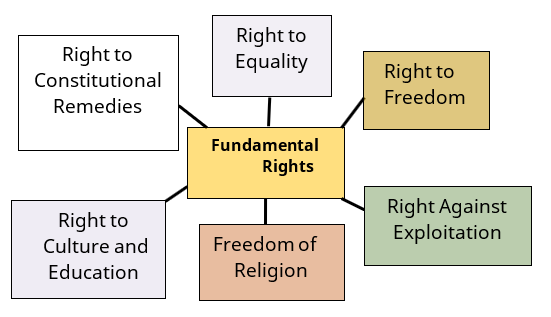
Explanation of Fundamental Rights
Article –12 – Definition
● Under this the State is defined and the State shall include the Government of India, the State Government Legislature and all local bodies and all such other authorities which have the power to make rules, to make laws, to issue orders and to issue notifications under the Constitution or law.
● Other authority includes such authorities or bodies as are created by the Constitution and which have the power to make laws or by–laws.
Article–13 – Laws inconsistent with or in derogation of Fundamental Rights.
● Provisions have been made in this article with respect to laws inconsistent with or derogating from the Fundamental Rights.
Note – The original constitution had 3 sections under it.
Article–13(i)
● It is mentioned in this that any pre–constitutional law shall become void if it is not consistent with the constitution.
Article–13(ii)
● It states that any law made after the Constitution came into force. That law would become void if it is not consistent with the Constitution.
Article–13(iii)
● It defines the word ‘method’. According to this, the word method includes laws, notifications, circulars, orders, rules, regulations, ordinances and practices made by the Parliament or the State Legislature.
Article–13(iv)
● In the year 1971 by the 24th Constitutional Amendment Act, a section named 13(4) was added under Article–13.
● The constitutional amendment made under the procedure of Article 368 does not include the term law as defined under Article 13(iii).
Preamble of Indian Constitution | भारतीय संविधान की प्रस्तावना
Committees of the Constituent Assembly UPSC & SSC NOTES
Eclipse Principle and Vesture
● If the law made before the commencement of the Constitution is inconsistent with any fundamental right, it will become inoperative and will not disappear. If the restriction imposed by the Fundamental Rights is removed, it will become active again.
Note – Article 13 is the basis of the principle of coverage.
Principle of Relinquishment
● The Constitution states that a person cannot voluntarily relinquish the fundamental rights guaranteed by the Constitution.
Principle of Severability
● If any part of an act is unconstitutional or against the fundamental rights, then without destroying the fundamental object of the act, only the part inconsistent with the rights will be declared unconstitutional and not the whole act.
Article –14 – Equality before the law
● It provides equality before the law or equal protection of the law. The provision of equality before the law is taken from the British constitution and equal protection of law from the United States.
● According to this system, all persons will be governed by the common laws of the country without any discrimination, that is, no person is above the law. Following the decision of the Supreme Court in Minerva Mills vs Union of India (1980), the rule of law enshrined in Article 14 has been declared as the basic structure of the Constitution.
Exception to equality before law
There are some exceptions to equality before the law, which are as follows:
1. (i) The President and the Governor are exempted from equality before the law. (Article–361)
(ii) Both the President and the Governor shall not be responsible to the judiciary for the exercise of the powers and duties of their office.
(iii) No criminal proceedings of any kind shall be initiated or continued against both of them during their tenure.
(iv) Civil proceedings can be initiated against the President and the Governor during or after their tenure.
2. If any person publishes in a newspaper (radio or television) the subject matter relating to the true proceedings of either House of Parliament or of the State Legislature, he shall not be prosecuted in any court of the country. (Article–361–A)
3. No member of Parliament or a State Legislature or a Parliamentary Committee or a State Legislature Committee shall be proceeded against in any court in respect of anything said or any vote given by him. (Article–105,194)
4. Foreign sovereigns (rulers), ambassadors and diplomatic persons would be free from civil and criminal cases.
5. The United Nations and its agencies are exempt.
Article –15
Prohibition of discrimination on grounds of religion, race, caste, sex or place of birth
⇒ Article –15 (i)
● The State shall not discriminate against any citizen on the basis of religion, race (origin lineage), caste, sex and place of birth.
⇒ Article –15 (ii)
● The state cannot discriminate against any citizen on grounds of religion, race (origin), caste, sex and place of birth in shops, restaurants, places of entertainment, public grounds, ponds, wells, bathrooms.
⇒ Article –15 (iii)
● The state will make special provisions for women and children.
⇒ Article –15 (iv)
Note – In Champakam Duraijan vs State of Madras (1950), the Constitution Bench abolished caste–based reservation in Madras. In order to eliminate the effect of the decision given in this case, in the year 1951 by the first constitutional amendment, a section named 15(iv) was added under Article–15.
● It is mentioned in Article 15 (iv) that the State may make special provisions in educational institutions for the socially and educationally backward citizens and people belonging to Scheduled Castes and Scheduled Tribes.
Article –15 (v)
- By the 93rd Constitutional Amendment Act, a section named 15(v) was added in the year 2006.
- It is mentioned in Article 15 (v) that reservation will be given for the backward classes at the time of admission in higher educational institutions, including private aided and non–aided educational institutions.
Note – In the case of Ashok Kumar Thakur vs Union of India (2008), the 93rd Constitutional Amendment was challenged on the ground of violation of infrastructure. This challenge was rejected.
⇒ Article –15 (vi)
● In the year 2019 by the 103rd Constitutional Amendment Act, a section named 15(vi) was added under Article–15.
● It is mentioned in Article 15 (vi) that the state will give 10 percent reservation to the general category economically backward people at the time of admission in educational institutions.
● These fundamental rights are only for Indian citizens. Under this, there is a provision to implement the basis of equality in particular areas. It prohibits discrimination of any kind on the basis of religion, race of origin, caste, sex or place of birth.
Article –16
Equality of opportunity in the matter of public employment
● Article 16(i) – Every citizen shall have equality of opportunity in employment and appointment in the services under the State.
Note – Freedom of reputation is implicit in this article.
● Article 16(ii) – The State shall not discriminate in the field of public employment to any citizen on grounds of religion, caste, place of birth, race, sex, origin and place of residence.
● Article –16(iii) – The state may make special provisions on the basis of the place of residence. Laws to do so would be made only by Parliament.
● Article –16(iv) – It is mentioned in this that provision of public employment reservation can be made for the socially and educationally backward citizens of the state and such people of scheduled castes and tribes who are not adequately represented in public employment.
Note – It is mentioned in Article 340 that within five years from the commencement of the Constitution, the President shall constitute a commission to find out the socially and educationally backward people.
Note – In the year 2001, through the 85th Constitutional Amendment, a provision was made in Article 16(iv)(A) that those who are promoted will get seniority.
● It was held in Mukesh Kumar Vs Uttarakhand (2020) that reservation in promotion is not a fundamental right.
Note –A new article named Article–16(iv)(B) was added in the year 2000 by the 81st Constitutional Amendment Act. A provision has been made under this article that the limit of 50 per cent can be exceeded while doing ‘backlog recruitment’.
Note – Article 335 of the original constitution provided that administrative efficiency would be taken into account while giving reservation in public services. In the year 2000, by the 82nd Constitutional Amendment, a provision was also made under Article 335 that the Scheduled Castes and Scheduled Tribes could be given relaxation in qualifying marks.
● In the M Nagaraj case, the Supreme Court decided to keep the following things in mind while giving reservation.
1. Backwardness – (i) Social (ii) Academic
2. Inadequate representation
3. Administrative Efficiency
● By the 117th Constitutional Amendment Bill, it was proposed to remove the word inadequate representation mentioned in Article 16(iv).
● Article 341 provides that any caste can be included in the Scheduled Castes by the President by issuing notification. In the case of states, the President can include any caste in the Scheduled Castes in consultation with the Governor.
● Article 342 provides that any caste can be included in the Scheduled Tribe by the President by issuing notification. In the case of states, the President can, in consultation with the Governor, include any caste in the Scheduled Tribes.
● In the 102nd Constitutional Amendment Act 2018, two new articles named 338B and 342A were added.
● After the decision given in the Indira Sawhney case, the National Commission for Backward Classes was established in the year 1993 through Parliamentary Act to study the condition of backward classes.
● By the 102nd Amendment Act, the National Commission for Classes was given constitutional status under Article 338B.
● Article 338B provides that any caste can be included in the backward class by issuing notification by the President. In the case of states, the President can include any caste in the backward class in consultation with the Governor.
Creamy Layers
● In the Indira Sawhney case, it was decided that the creamy layer should be kept out of the purview of reservation.
● The Supreme Court said that the standards of creamy layer will be set by the government.
● By the order of the Supreme Court, a committee was constituted by the government under the chairmanship of former judge of Patna High Court Ramanandan Prasad for the determination of creamy layers. This committee laid down two grounds for the determination of creamy layers.
(i) Income and (ii) Post
● The concept of creamy layers is applicable only to the Backward Classes (OBC).
● In Jannail Singh Vs Laxminarayan Gupta (2018), it was held that the concept of creamy layers can be applied to Scheduled Castes and Scheduled Tribes also. But it is up to the government to implement it.
⇒ Article –16(v)
● It is mentioned in this that the provisions of reservation will not be applicable in respect of certain posts.
⇒ Article –16(vi)
● A new section named 16(vi) was added in the year 2019 by the 103rd Constitutional Amendment Act.
● It is mentioned in Article 16 (vi) that the economically backward people of the general category will get 10 percent reservation in public employment.
Note – Before the 103rd Constitutional Amendment, the word economic backwardness was not mentioned in the Constitution.
| Educational Reservation –Article –15[4]Article –15[5]Article –15[6]Reservation in jobs–Article –16(4)Article –16(4)AArticle –16(4)BArticle –335Article –16(6) | |||||
| Political Reservation – | |||||
| Article | Provision | ||||
| 330 | Reservation of Scheduled Castes and Scheduled Tribes in Lok Sabha | ||||
| 331 | Provision of Anglo–Indians in Lok Sabha | ||||
| 332 | Reservation of Scheduled Castes and Scheduled Tribes in the Legislative Assembly | ||||
| 333 | Provision of Anglo Indians in the Legislative Assembly | ||||
| 243 D | Reservation for Scheduled Castes and Scheduled Tribes in Panchayats | ||||
| 243 T | Reservation for Scheduled Castes and Scheduled Tribes in Municipalities | ||||
Note – Under the 104th Constitutional Amendment Act, 2020, the reservation of Scheduled Castes and Scheduled Tribes has been further extended by 10 years.
Note – By the 104th Constitutional Amendment Act, 2020, the provision of nomination on the basis of Anglo–Indians Article–331 and Article–333 has been abolished.
Reservation on economic basis
● Two new Articles–15(6) and 16(6) have been added through the 124th Constitutional Amendment Bill (103rd Amendment Act). This constitutional amendment also ensures the provision of reservation on economic grounds to ensure social justice.
● This amendment says about the definition of economic backwardness – “The State may from time to time determine an ‘economically backward community’ by using indicators of family income and other economic deprivations.” In this way, the state has made the following grounds mandatory for reservation to the economically backward community–
● Family income should be less than Rs.8 lakh per annum. It is to be noted that at present the limit of OBC creamy layer is also 8 lakh rupees.
● Have less than 5 acres of agricultural land.
● The size of the residential accommodation should be less than 1000 square feet.
● Residential plot in municipal notified area should be less than 100 yards.
● Residential plot less than 200 yards in non–municipal notified area.
● The 50% limit was most effectively laid down in the Indra Sawhney case (1992). The reservation (49.5%) provided before the 103rd amendment was in line with the total prescribed limit (50%). Providing 10% more reservation is against the earlier decisions of the Supreme Cour
Article –17
Abolition of Untouchability
● It ends the evil untouchability prevalent in the Indian society and makes arrangements to punish those who support untouchability. The Parliament, exercising the power under Article 17, enacted the ‘Untouchability Offenses Act, 1955’, which was again amended in 1976 and renamed ‘Protection of Civil Rights Act, 1955’. Article 17 is a self–executing law, that is, on its violation, the court can punish directly on the basis of the Indian Penal Code.
Article –18
Prohibition of titles
● Under this, other titles except education and army have been abolished.
(i) No Indian citizen can obtain any title from any other country.
(ii) Any person who is working under the Government of India cannot obtain a title from any foreign state.
(iii) No person holding an office of profit under the Government can take a title from any other country without the permission of the President.
⇒ Article –19
Protection of certain rights regarding freedom of speech etc.
● A total of 7 freedoms were provided to all citizens by the Constitution of India in the beginning under Article – 19(1), but, the right to acquire, hold and dispose of property provided in Article–19(1)(f) was abolished by the 44th Amendment Act of 1978
● At present, 6 freedoms have been provided to all citizens under Article 19(1) by the Indian Constitution–
1. Article 19(1)(a) – Freedom of speech and expression
2. Article 19(1)(b) – Freedom of conference peaceful and free war
3. Article 19(1)(c) – Freedom to form association, organization or co–operative society (added under 97th Constitutional Amendment Act, 2011)
4. Article 19(1)(d) – Freedom of movement or movement
5. Article 19(1)(e) – Freedom of residence
6. Article 19(1)(f) – Repealed (Abolished by 44th Constitutional Amendment 1918)
7. Article 19(1)(g) – Freedom of employment or livelihood
Note – It is an inherent right of Indian citizens in this article to temporarily park along the roadside.
Note – The Constitution Bench in Jayshree Laxmirao Patil vs Chief Minister of Maharashtra (2021) struck down the Maratha reservation in its decision. In this case the following decision was given.
(i) Reservation cannot exceed 50%. (Indira Sawhney case)
(ii) The 102nd Constitutional Amendment does not violate the basic structure of the Constitution. Therefore they are constitutional.
● Article 19 (i) (a) Freedom of speech and expression is also mentioned in the Preamble.
Note – Freedom of the press is not explicitly mentioned in any article of the constitution. It is considered a part of freedom of expression.
Note – Damodar Swaroop Seth and Prof. K. T. Shah had proposed to mention the freedom of the press in the Constitution in the Constituent Assembly.
Note – In ADR vs Union of India (2002) it was held that the disclosure of background information of candidates is a part of freedom of expression.
Note – In Naveen Jindal Vs Union of India (2004) it was held that the raising or hoisting of the Presidential flag is part of the freedom of expression.
Note – In the case of PUCI vs Union of India (2013), NOTO is part of freedom of expression.
Note – In Shyam Narayan Chouksey vs Union of India (2016), it was held that the playing of the national anthem in cinema halls is mandatory. Currently voluntary.
● Article – 19(2) – Article 19(1)(a) can be banned on the grounds of promoting the unity and integrity of the country, public order, morality and courtesy, defamation, contempt of court, friendly relations with foreign countries and promoting crimes.
● Article – 19(3) – Article 19(1)(b) can be banned on the basis of country’s unity and integrity and public order.
● Article – 19(4) Article 19(1)(c) can be banned on the basis of country’s unity and integrity, public order and morality.
● Article – 19(5)– In the interest of the general public and on the basis of protection of the interests of the Scheduled Tribes, Article–19(1)(d) and Article–19(1)(e) can be banned.
● Article–19(6) – Article–19(1)(g) can be banned in the interest of the general public.
Due to the limitations mentioned in Article 19, the member of the Constituent Assembly, Prof. K. T. Shah, had said that something was given with the right hand but everything was taken away with three or four left hands.
Note – Freedom to move freely and to live or settle can be curtailed to protect the interests of Scheduled Tribes.
Note – In the Constituent Assembly, H.V. Kamath had proposed freedom to keep arms.
● The first amendment was made in the year 1951 to eliminate the effect of the decision given by the Supreme Court in the year 1950. By this amendment, a word like ‘public order’ was added in Article 19.
● By 16th Amendment 1963, word Unity and Sovereignty were added in article 19.
⇒ Article–20– Protection in respect of conviction for offenses
● Under Article 20, individuals have the following constitutional protection in respect of offenses against the State.
● Protection from ex–officio laws Article–20(1)
Article 20(1) states that a person shall be convicted only on the ground of violation or contravention of the law in force.
● Protection from double punishment– Clause (2) of Article 20 states that no person shall be ‘punished’ or ‘prosecuted’ more than once for the same offence.
● Protection from self–incrimination Article 20(3) states that no person, who is an offender, shall be compelled to give evidence against himself.
Note – The use of narco, brain mapping, lie detector has been prohibited on the basis of Article 20 in Selvi vs State of Karnataka (2010).
⇒ Article 21 – Protection of life and personal liberty
● Article 21 states that no person shall be deprived of his life and personal liberty except by law or procedure established by law.
● In AK Gopalan vs State of Madras, AIR 1950, the Supreme Court held that in Article 21 the Legislature may by law deprive any person of the right to life and personal liberty.
● In the case ‘Maneka Gandhi Vs Union of India AIR 1978’, the Supreme Court reversed its decision in the Gopalan case and ruled that the protection under Article 21 is available not only against the arbitrary action of the executive but also against the proceedings of the legislature. That is, the legislature cannot by law deprive any person of his right to life and personal liberty.
● Part 3 of the Constitution is called as Backbone of the Constitution and Magna Carta of Constitution by B.R. Ambedkar
● In the 44th Constitutional Amendment Act, 1978, Parliament amended Article 359 and clarified that the right to freedom given in Articles 20 and 21 cannot be suspended even in emergency.
Note – In the case of Begum Husn Aaran Khatoon vs State of Bihar (1978), it was held that every person has the right to an expeditious trial of his cases.
● In the case of Bandhua Mukti Morcha vs Union of India (1983), it was held that the right to health is also a part of Article 21.
● In the case of Parmanand Katara vs Union of India (1989), it was held that it is a part of Article 21 to ensure that all persons get proper treatment at the right time.
Note – In Vishakha vs Rajasthan (1997), it was held that the protection of women from sexual harassment at work place is part of Article 21.
Note – In Navtej Kaur vs Union of India (2018) case, homosexuality relationship is considered as part of Article 21 of the right to privacy.
Note – In this case, Section 377 of the Indian Penal Code is not completely abolished, but the part declaring homosexuality as an offense has ended.
● In Joseph Signe vs Union of India (2018), it was held that IPC (Indian Penal Code) Section–497 violates Articles–14 and 21.
● The case of Tehseen Poonawalla vs Union of India (2018) deals with mob lynching. In this case, considering mob lynching as a violation of Article 21, it was called a blot on democracy and rule of law.
● In Common Cause vs Union of India (2018), it was held that Article 21 includes the right to die with dignity. That is, it is part of Article 21 to perform cremation with respect after death.
⇒ Article–21(a)– Fundamental Right to Education
● A new Article 21(a) was added to the Constitution by the 86th Constitutional Amendment Act–2002, which includes the right to elementary education. Article 21(a) states that it shall be the duty of the State to provide free and compulsory education to all children in the age group of 6 to 14 years. For the implementation of the Fundamental Right to Education, the Parliament passed the ‘Right to Education Bill–2009’ which came into force from 1st April, 2010. Rajasthan implemented it from 1st April, 2011.
⇒ Article 22– Protection from arrest and detention
● Article 22 provides protection against arrest and detention. There are two types of arrests–
(i) under common criminal law
(ii) under preventive detention law
● Article 22 provides for the following rights with respect to arrest under the general penal law–
(a) Cannot be arrested against the order of a Magistrate for more than 24 hours.
(b) The right to be informed as soon as possible of the reasons for the arrest.
(c) The right to be consulted and defended by a legal practitioner of his interest.
⇒ Article –23– Prohibition of human trafficking and forced labor
● Article 23 prohibits trafficking in human beings and begar and other forms of forced labor. Article 23 provides protection against both the state and private individuals.
● ‘Human–trafficking’ includes buying and selling of human beings (men and women) like things, doing immoral trade (prostitution) of women, children and slavery.
Parliament has the power to make laws related to human trafficking. Article 23 provides protection to persons from forced labor and other forms of forced labour.
⇒ Article –24 – Prohibition of employment of children in factories etc.
● Under Article 24, employment of children below the age of 14 years in factories, mining or any other hazardous work is prohibited.
Note – The Child Labor (Prohibition and Regulation) Act, 1986 has been enacted to fulfill the purposes of Article–24.
⇒ Article–25– Freedom of conscience and freely professing, practicing and propagating religion
● Freedom of conscience – the inner freedom of any individual to make his own relationship with God or his forms in his own way.
Note – In the case of Shayra Bano vs Union of India (2017), triple talaq (talaq–e–viddat) was banned.
Note – It is also mentioned in Article 25 that all Hindu religious institutions shall be open to all classes. Here the word Hindu also includes Jain, Buddhist and Sikh.
Note – Indian Young Lawyers Asst. Vs State of Kerala (2018) pertains to the Sabarimala temple in Kerala. In this case, on the basis of Article 14, 17, 21 and 25, the ban on entry of women to the temple was removed.
⇒ Article –26– Freedom to manage religious affairs
● According to Article 26, every religious denomination or any section thereof shall have the following rights–
(a) Right to establish and maintain institu–tions for religious and charitable purposes;
(b) Right to manage its own affairs in matters of religion;
(c) Right to own and acquire movable and immovable property; and
(d) Right to administer such property in accordance with law.
⇒ Article –27 – Freedom as to payment of tax for promotion of a particular religion
● No person shall be compelled to pay taxes for expenditure incurred in the promotion or maintenance of any particular religion or religious sect. Taxes can be used for the maintenance and progress of all religions.
⇒ Article –28– Freedom to attend religious instruction or religious worship in certain educational institutions
● Under Article 28, no religious education should be given in any educational institution fully funded by the state funds. However, this arrangement does not apply to those institutions, which are administered by the state but have been established under some endowment or trust.
⇒ Article–29– Protection of interests of minorities
● These fundamental rights are related to the rights of minorities.
● According to the order of the Supreme Court (Ashwini Kumar Vice President Vs Union of India 2020), the minority is determined on the basis of the population of the country and not on the basis of the population of the state.
⇒ Article –30– Right of minorities to establish and administer educational institutions
Article–31– Right to Property (Repealed)
| Article–31 | Property Rights |
| Article–31A | The state can acquire property. |
| Article–31B | The law cannot be challenged in court. |
| Article–31C | Article–39B and Article–39C will be given priority over Fundamental Rights. |
| Article–31D | A law involving anti–national activities cannot be challenged in court. |
⇒ Right to Constitutional Remedies (Article –32)
● Article–32 The Right to Constitutional Remedies. Dr. Ambedkar has called the ‘heart and soul of the Indian Constitution’ and the ‘Rampale of the Constitution’. Any person from the entire Indian territory can directly appeal to the Supreme Court to protect his fundamental rights.
The following are the major writs or documents
● Habeas corpus – It literally means ‘to be presented or to have a body’ This writ is issued against a person or authority who has illegally detained a person. According to this, the court causes the detained or imprisoned person to appear before it.
● Mandamus – It literally means– ‘We give orders or wakening call’. This writ is used to order an officer who refuses or neglects to perform public duties.
● This writ cannot be issued against the President and the Governor.
● Prohibition – It means– ‘to refuse or to stop.’ It is hereby prohibited from exercising jurisdiction which is not vested in it. This writ is issued only against judicial or quasi–judicial acts. Just as the mandate is directly active, the prohibition is not directly active.
● Certiorari – It literally means– ‘to give information or to be certified’. It is similar to prohibition document because both are issued against subordinate courts, but the main difference between both the documents is that during the course of the proceedings, a writ of injunction is issued to stop the proceedings whereas writ of eviction is the decision on the termination of the proceedings. issued for cancellation.
● Quo warranto – It literally means ‘by any authorization or warrant.’ If any office has been held by any person illegally, then the court asks for the basis of his office through this writ. Unlike the other four writs, it can be issued by any person interested and not by the victim. It cannot be issued for ministerial and private office.
Note – It is mentioned in Article–32(iii) that Parliament can by making law give the right to issue writ to other court also.
Note – Dr. Ambedkar called Article–32 the soul of the Indian Constitution.
Note – The High Court has more power than the Supreme Court to issue petitions. There are two reasons for this–
(i) The High Court issues 6 petitions on the basis of Article 226. And under Article 226, the High Court also issues a petition named Injunction. Under this petition the person ‘interim relief’ is provided.
(ii) Supreme Court issues petitions only for the protection of fundamental rights whereas High Courts issues petitions for fundamental rights as well as other legal rights.
Note – Both the Supreme Court and the High Court have the power to issue petitions.
⇒ Article –33
● It is mentioned in Article 33 that in order to maintain discipline, the fundamental rights of the people connected with the military, investigation, public order can be reduced by Parliament by law.
⇒ Article –34
● It empowers the Parliament to indemnify any government servant or any other person for any act done by him in connection with the maintenance or restoration of order in any area where martial law was in force.
⇒ Article –35
● It is mentioned in this that only Parliament has the right to make laws with respect to Article 16 (iii), Article 32 (iii), Article 33 and Article 34. The state legislature does not.
Note – Article–15, Article–16, Article–19, Article–29 and Article–30 are available only to Indian citizens.
Public Interest Litigation
(1) The acceptance of a petition by the Supreme Court or High Court to protect the fundamental rights of the people is called Public Interest Litigation or Public Interest Litigation.
(2) The word like public interest litigation is not mentioned in the constitution. This concept is taken from America. PN Bhagwati was the 17th Chief Justice of India. He is called the father of public interest litigation in India.
Riverside cities of india | भारत की नदियों के किनारे बसे शहर
Note : If you are preparing for UPSC, SSC or any other exam then definitely join us.
1 thought on “Fundamental Rights : Article 14 to 35 Notes”