
In this post, we are reading about the Chemical Composition of DNA and RNA which you read in biology subject but we are providing you notes prepared in a simple and easy way so that you can clear this topic in a short time and clear it, you have been provided all the information related to this topic below.
Chemical structure of DNA
DNA is a polymer of nucleotides.
Chemical Structure of RNA
Note –
– Sugar + nitrogenous bases + phosphate group = nucleotides
– Sugar + nitrogenous bases = nucleosides
– Adenin (A) + Guanine (G) = Purine Base
– Thiamine (T) + Cytosine (C) = Pyrimidine base
Physical structure of DNA
– DNA consists of two polynucleotide chains linked to each other.
– In 1953, James Watson and Francis Crick presented a 3-D model of the double helix structure of DNA.
– According to them, two polynucleotide chains in DNA are linked to each other by H-bonds.
– Franklin and Wilkinson studied the structure of DNA with the help of X-ray crystallography.
– In 1962, Watson, Crick and Wilkinson jointly received the Nobel Prize for describing the structure of DNA.
– In both polynucleotide chains, purines and pyrimidines (N2-bases) form H-bonds.
– Cytoplasm – DNA and prokaryotic DNA have more base-pair, hence their melting point is higher.
Denaturation of DNA
– When the temperature is 90oC or more, the two strands of DNA separate from each other. (by breaking the H-bond)
DNA Annealing
– On reheating, these chains are joined together.
– On reheating, these chains are joined together.
– After a certain interval in the base pair/BP of DNA, certain parts of the base pair are repeated. Such repeating base pairs are called ‘VNTR’ (Variable Number of Tandem Repeats), due to which polymorphism is found in DNA, which is the basis of DNA finger printing.
Notes :
– DNA generally shows a double helical structure. Many viruses such as phage virus, bacteriophage/bacterial virus have SS DNA (single strand DNA).
– DNA activity is less than that of RNA while stability is high.
– The small parts of DNA that determine our traits are called genes.
(ii) RNA – Ribonucleic Acid
– RNA is found in all organisms (animals+plants) except some viruses.
– RNA is mainly found in the cytoplasm of the cell and to a lesser extent in the nucleus.
– RNA is also found in mitochondria and plastids.
– The main function of RNA is to perform protein synthesis in the cell.
– How RNA is made in the cell, it was first shown by S. Okoa and Kornberg.
– RNA is more active than DNA and they are helpful in the synthesis of substances other than proteins in the cell.
– RNA groups that have catalytic activity similar to enzymes are called ribozymes.
– Unlike DNA, RNA does not show a double helix structure but is found only as a single strand.
Chemical Structure of RNA
– RNA is also a polynucleotide molecule.
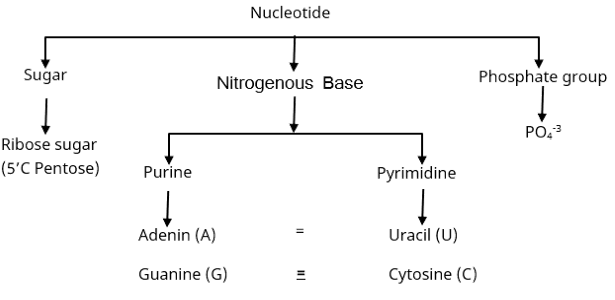
There are mainly two types of RNA-
(i) Genetic RNA
(ii) Non-Genetic RNA
(i) Genetic RNA
– They are also helpful in RNA inheritance.
– RNA is found in viruses/retroviruses.
(ii) Non – Genetic RNA
– RNA is found in all organisms except viruses.
– It is related to protein synthesis. There are three types of them-
(a) m-RNA (messenger/RNA) message conveyer – 5%
(b) r-RNA (ribosomal RNA) – 80%
(c) t-RNA (transfer RNA) – 10-15%
(a) m-RNA – The information about protein synthesis from the nucleus comes into the cytoplasm.
(b) r-RNA – Relative to ribosomes in the cytoplasm and it carries out protein synthesis.
(c) t-RNA – It transfers information related to amino acids for protein synthesis.
Central Dogma of Protein Synthesis
– Francis Crick told about the central dogma of protein synthesis.
– Under the central dogma principle, the process of making m-RNA from DNA is called transcription.
– Under the central dogma principle, the process of making proteins from m-RNA is called translation.
–
– Temin and Baltimore first told about ‘reverse transcription’.
- Speedy Current Affairs November 2025 Pdf Free Download
- Africa Continent, Major Countries, Straits and Lakes
- Asia continent, Major countries, Jalasandhi and Lakes
- Vision Ias Today Current Affairs 10 May 2025
- Vision Ias Today Current Affairs 8 May 2025
Note : If you are preparing for UPSC, SSC or any other exam then definitely join us.