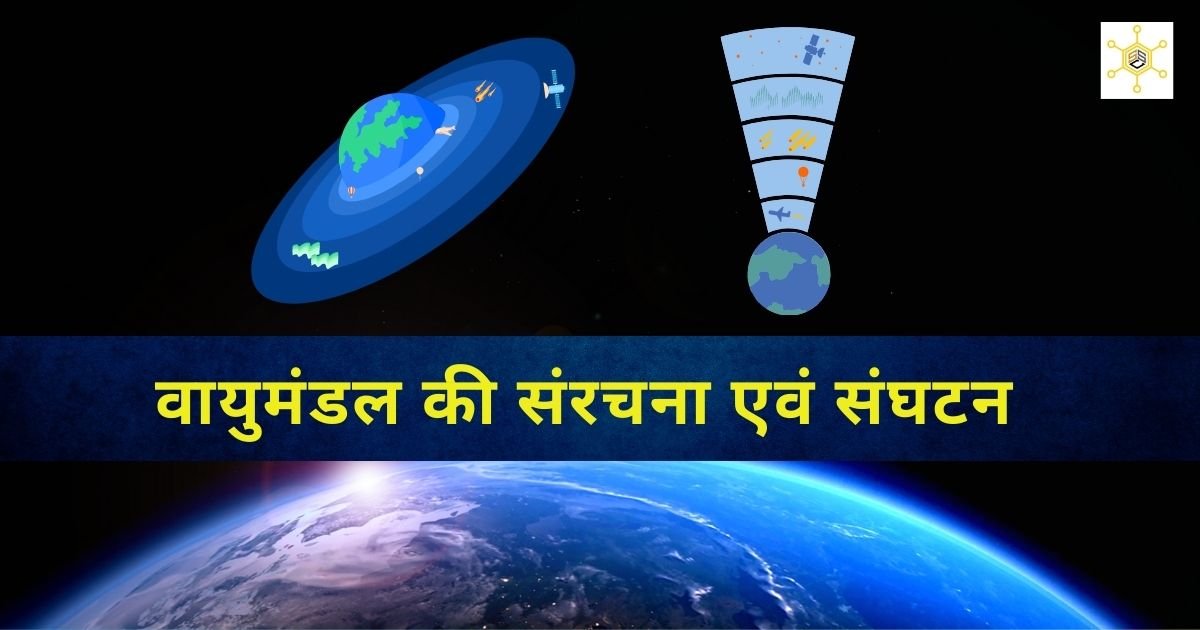
Atmospheric Structure and composition : In this post, we have provided notes about the structure and composition of the important topic of geography subject, in which you have been provided complete information about the atmosphere as important for your exam, if you read this topic from here, you will not need to read it again anywhere.
These notes of the atmosphere have been prepared from offline classrooms so that you can be provided a good study material, if you are preparing for the SSC exam sitting at home, then these notes will work like a panacea to you.
Atmospheric Structure and composition
Major Statue of India | भारत के प्रमुख स्टैचू
• Atmosphere is the wide reservoir of air around the earth. It allows short waves of solar radiation to reach the earth’s surface but becomes a barrier to long waves of terrestrial radiation. In this way, it acts like a giant glass house by holding the heat, due to which the average temperature on Earth is maintained at 15 °C. This temperature is the basis for the development of the biosphere on Earth.

(1) Non-Volatile gases- Nitrogen, oxygen, argon, helium are the major stable gases.
(2) Volatile gases – CO2, ozone, methane, water vapour.
(3) Noble / inactive / inert gases – Their value is zero in the molecular weight element table, they remain completely inactive in biological units such as argon, neon, helium, krypton.
(4) Greenhouse gases – CO2, methane, nitrous oxide, chloro-fluorocarbons, water vapor, ozone.

Composition of Atmosphere
The atmosphere is a mixture of many gases, in which particles of solids and liquids float in unequal amounts. Nitrogen is in the highest amount. After that comes the place of gases like oxygen, argon, carbon-di-oxide, neon, helium, ozone and hydrogen respectively. Apart from this, water vapor, dust particles and other impurities are also present in the atmosphere in unequal amounts. Water vapor, dust particles and ozone are very important for the weather conditions of the world.
Ozone – Although its quantity is very less in the atmosphere, but it is an important component of the atmosphere. It acts as a filter and absorbs the radiation of the ultraviolet rays of the sun. If these rays had reached the surface, there would have been a sharp rise in temperature and the risk of skin cancer would arise. This gas is found in the lower part of the stratosphere. Its presence occurs up to a height of 15 to 50 km, but it is found intensively at an altitude of 15 to 35 km.
Water vapour – Its amount in the atmosphere varies from 0 to 4%. It is found up to 4% in tropical regions and up to 1% in desert and polar regions. The amount of water vapour decreases with altitude. Half of the total amount of water vapour is found up to an altitude of 2000 m.
Dust Particles – These mainly include sea salt, fine soil, soot of smoke, ash, pollen, dust and meteorite particles. They are mainly found in the lower level of the atmosphere i.e. troposphere. The amount of dust particles is more in the sub-tropical and temperate regions than in the polar and equatorial regions. These dust particles are hygroscopic centers where atmospheric water vapor condenses and causes the generation of various forms of precipitation. Dust particles also act to block and reflect insolation. They also produce red and orange colored streams in the sky by scattering of light at sunrise and sunset. Dusty fog is also a thick haze formed in the presence of dust particles.
Composition of the atmosphere
• Although the expansion of the atmosphere is found up to an altitude of about 10000 km, but 99% of the mass of the atmosphere is limited to only 32 km. The atmosphere can be seen by dividing it into 5 different levels.

Troposphere – It is found up to a height of 8 km at the poles and 18 km at the equator. In this zone the temperature decreases by 1°C for every 165 meters of altitude and by 6.5°C for every one kilometer of altitude. This is called the normal heat loss rate. All the weather activities in the atmosphere are found in the troposphere. For example, storms, cyclones, cloud formation.
Stratosphere – In this zone, the temperature is stable in the beginning, but after the height of 20 km, there is a sudden change in temperature. This is due to the presence of ozone gases which increase the temperature by absorbing ultraviolet rays. This circle is free from seasonal movements, so the pilots prefer to fly here.
Mesosphere – The height of this circle varies from 50 to 80 km. In this there is a sudden drop in temperature and the temperature drops to -100°C.
Ionosphere – Height (80-640 km) There is an abundance of electrically charged particles and the temperature starts increasing with height. Radio waves are reflected from this layer of the atmosphere.
Exosphere – Height (640-1000 km) In this also electrically charged particles predominate and there are different layers of N2, O2, He, H2 respectively. Atmosphere becomes very rare after 1000 km in this circle and finally after 10000 km altitude it gradually merges into space.
Note : If you are preparing for UPSC, SSC or any other exam then definitely join us.
1 thought on “Atmospheric Structure and composition Notes | वायुमंडल की संरचना”