
Indian Polician is a subject that is also very important for the Civil Service Examination as well as SSC CGL, CHSL, UPPSC and other exams. If you want to prepare with the notes related to this subject, then in this post we have made the classroom notes related to Indian constitutional development below, you must remember them for the upcoming examination and follow them for the same notes and follow our website for the same notes with such notes.
Indian constitutional development
● The laws and rules which were made to operate the governance system in India during the British rule, which later became useful for constitution making in the Indian context, this process is called constitutional development.
● Under the Charter Act of 1600 AD, the 24–member East India Company was established in London on December 31, 1600.
● These 24 members were named “Board of Directors” (Operator or BOD).
● The Board of Directors was given the right to do business in the Eastern countries (for the initial 15 years).
● In 1608 AD, “Captain William Hawkings” came to India as the first representative of the East India Company.
● Captain William Hawkings unsuccessfully met the Mughal emperor Jahangir in Agra to trade in India.
● The East India Company established its first trading center/kothi in Surat in 1613 AD.
● In December 1615, “Sir Thomas Roe” came to India and on January 10, 1616, he met the Mughal emperor Jahangir in the fort of Akbar in Ajmer and obtained permission to do business in India.
● In 1617, the East India Company established the first trading center/kothi of southern India at Moosalipatnam/Machhalipatnam near Madras.
● The city of Calcutta was established in 1700 AD.
● Under the Charter Act of 1726 AD, for the first time adopting the system of decentralization, separate governors were appointed in Bengal, Bombay and Madras Presidencies.
● The “Battle of Plassey” of 1757 AD is considered to be the first attempt of British power in India.
● After the Battle of Buxar in 1764, the British Empire was established in India.
Regulating Act of 1773
● This act was approved by the British Prime Minister Lord North.
● The main purpose of this act was to establish control of the British Parliament over the East India Company.
● Under this Act, Bombay and Madras Presidencies were brought under Bengal Presidency for the first time by adopting the system of centralization.
● The right to make laws in these three presidencies was given to the Governor General of Bengal and its 4–member council.
● Under this act the post of Governor General was created in Bengal.
● Warren Hastings became the first Governor General of Bengal.
● Under this act, Apex Court was established in Calcutta in 1774 AD. In which a Chief Justice and three other judges were Appointed.
Pitt’s India Act of 1784
● This act was named after the British Prime Minister “William Pitt”.
● Under this, the functions of the East India Company were divided into two parts, commercial and political.
● The business functions were kept unchanged with the “Board of Directors”.
● 6 member “Board of Control” (BOC) was established for political work.
● Under this act, “Dual rule/Dual rule” was implemented in relation to the company’s work through “BOD” and “BOC”, which lasted till the year 1858.
Charter Act of 1813
● Under this act, the monopoly of trade of East India Company was abolished except the monopoly of trade in tea and trade with China.
● Announced that other European citizens can also do business in India.
● Christian missionaries were given the right to propagate religion and do business in India.
● Provision was made under this Act that the company would spend Rs 1 lakh annually on education in India and 20,000 English soldiers would be kept in India at its own expense.
Charter Act of 1833
● The monopoly of trade of East India Company for tea trade and trade with China was abolished.
● Under this act, the East India Company’s right to do business was abolished and it was announced that the company would only do political work from now on.
● Under this act, the “Governor General of Bengal” was declared as the “Governor General of India” and the right to make laws in British India was given to the Governor General and his four–member council. Provision was made to include one law member in these 4 members.
● Under the chairmanship of Macaulay, a four–member Law Commission was constituted in 1834, whose main function was to record the rules and laws issued for India and the enactments to come.
● Lord William Bentick became the first Governor General of India and was the last Governor General of Bengal.
Charter Act of 1853
● This was the last Charter Act in the series of Charter Acts.
● Under this act, the political work of the East India Company was divided into administrative and legislative.
● Administrative functions were entrusted to the Governor General and its 4 members to the Executive.
● Note– For the first time 12 member Legislative Council was constituted for legislative work. Which was named “Indian Central Legislative Council”.
● In this Act, a provision was made for the conduct of “Open Competitive Examination” for the Civil Services Examination.
● Under this Act, 1854 ‘Macaulay’ Committee was constituted to make suggestions regarding the inclusion of Indians in the specialized civil services.
Government of India/Government Act of 1858
[NOTE –, The Acts of 1858, 1919 and 1935 are known as the Government of India/Government Act.]
● This act was introduced in February, 1858 during the tenure of British Prime Minister Palmsturm and passed in August, 1858 during the tenure of Prime Minister Lord Derby.
● Under this act, all the powers of the East India Company were transferred to the British Emperor. The post of “Secretary of India” was created to use the powers of the Emperor in the context of India. A 15 member “India Council” was formed to assist the Secretary of India.
● The Board of Directors and Board of Controllers were abolished by including representatives of the Board of Directors and Board of Controllers in the Council of India.
● The India Secretary and the headquarters of the Council of India were located in London.
● The Secretary of India was a member of the British Parliament. For this reason it was not responsible to the Indian people but to the British Parliament.
1. Note – Lord Stanley was appointed as the first India Secretary.
2. Note – William Hare was appointed as the last India Secretary.
● The Governor General was declared the direct representative of the British monarch in India and was given the designation “Viceroy” as the representative of the Emperor.
Note – Lord Canning became the first Viceroy of India. (Last Governor General of British India)
● The proclamation made by Queen Victoria regarding the Act of 1858 was read out by Lord Canning in the court held at Allahabad on November 1, 1858.
● The educated class of India called this act “Magna Carta of their rights”.
India Council Act of 1861
● Under this act, the Viceroy Lord Canning included Indians in the Legislative Council for the first time for legislative work under the principle of regional representation.
● This act is considered to be the real beginning of constitutional development.
● Under this act, Lord Canning introduced departmental system and ministerial system.
● Under this Act, for the first time in 1862, High Courts were established in Calcutta, Bombay and Madras.
● Under this act, the Viceroy was given the power to form new provinces, veto bills and issue ordinances.
● By this act the Bombay and Madras Presidencies were made independent from the control of Bengal Presidency, changing the system of centralization made under the Regulating Act of 1773 to decentralization again.
India Council Act of 1892
● The number of members of the Legislative Council was reduced to a minimum of 10 and a maximum of 16.
● For the first time the electoral system was adopted but it was completely indirect.
● Under this act, representative government and parliamentary government were introduced indirectly.
India Council Act of 1909
Other names
⇒ Marley–Minto Reform Act
(India Secretary) (Viceroy)
● The Secretary of India, Lord Marley and the Viceroy of India, Lord Minto made a reform plan in 1906. To examine this reform plan, the “Sir A. Aruland Committee” was constituted in 1906. Implementation in India–
● Under this act, for the first time, “Satyendra Prasad Sinha” was included as the first Indian member in the Viceroy’s executive to make Indians a participant in administrative work, he was made a law member.
● The participation of Indians in legislative work was also increased, the name of the Indian Central Legislative Council was changed to “Colonial Legislative Council”, and its number of members was increased to 60.
● For the first time, voting was granted by adopting direct election.
● Voting was given to 3% of the total population, the minimum age of voting was fixed at 25 years, women were not given the right to vote. Property, taxes, titles were the basis of suffrage.
● Provinces and Indian members were also given the right to ask supplementary questions on the budget.
♦ Government of India/Government Act of 1919
● There were two main reasons behind the issuance of this Act–
1. Home Rule Movement of the year 1916.
2. Report of the Mesopotamia Commission of the year 1916 in which the British Government was described as a failure in India.
● On 20 August 1917, the British Government announced for the first time that our aim was to establish responsible governance in India.
● The preamble of this Act was made “Establishment of Responsible Governance”.
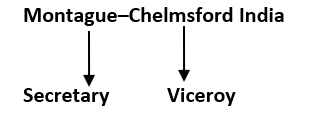
● In 1918, Indian Secretary Montagu and Viceroy Chelmsford prepared a plan which was implemented on 1st April, 1921 under the name of Act of 1919.
● In this act, instead of establishing responsible government, provisions were made to favor an influential section of India (Congress) in favor of the British government for 10 years.
● In this act, the participation of Indians in both administrative and legislative work was increased.
● Provision was made to include three Indians as members of law, education and industry in the Viceroy’s executive committee, increasing the participation in administrative work.
● Under this Act, for the first time a bicameral legislature was established at the Centre.

● Under this act, a unicameral legislature was formed in the form of Legislative Council in the provinces.
● Membership Minimum – 60
● Membership Max – 140
● Under this Act, for the first time, through two lists, the powers were divided between the center and the provinces.
1. Central List
2. Provincial List
● Under this act, dyarchy was implemented in eight provinces on April 1, 1921, dividing the subjects of the provincial list into reserved and transferred two parts.
● Eight provinces were Bengal, Bihar, Assam, United Provinces, Central Provinces, Bombay, Madras and Punjab.
● Under this act, the provincial budget was separated from the central budget and the provinces were given the right to make budgets.
● Under this act, on the recommendation of the “Acworth Committee”, the general budget and the railway budget were separated.
● In this act, the Public Accounts Committee was constituted and the post of Control and Accounts General (CAG) was created and women were also given the right to vote.
● Separate electorates were also extended to Sikhs, Indian Christians, Europeans and Anglo Indians, including Muslims.
● Provision was made for the formation of Public Service Commission in this Act. It was named Imperial (Union) Public Service Commission.
● It was established on October 1, 1926 under the chairmanship of Sir Rose Barker.
● The membership of the Council of India in London was reduced to a minimum of 8 and a maximum of 12.
● Liberals called this act the “Magna Carta” of India. Provision was made for the constitution of a 10–year commission to review this act.
Simon Commission (White Commission)
● Formed on 8th November, 1927 by India Secretary Birkin Head
● Member – 7 (All britisher)
● President– John Simon
● Reason for formation – To review the Act of 1919
● Arrived in India – Bombay on 3 February 1928
● Opposed– by Congress + all parties
● Cooperation – B.R. Ambedkar + Sahnawaz Hussain faction of Muslim League party.
● Report– in 1930
● Consideration of the report – 3 round table conferences organized
1. 1930 2. 1931 3. 1932
● Congress participated only in the Second Round Table Conference of 1931 under the leadership of Mahatma Gandhi.
● Congress participated in this Round Table Conference on the basis of Gandhi–Irwin Pact in Delhi on March 05, 1931 with the efforts of Tej Bahadur Sapru.
● On August 16, 1932, British Prime Minister Ramsay Macdonald announced the Communal Arbitration Award, in which 11 communities, including Dalits, were given separate electorates.
● Due to the arrangement of separate electorates for Dalits, Gandhiji went on a fast on 20 September 1932 in Yerwada Jail (Pune Maharashtra).
● On 26 September 1932, with the efforts of Rajendra Prasad and Madan Mohan Malviya, Poona Pact was signed between Gandhiji and Ambedkar, in which it was agreed to reserve seats for Dalits under the joint Hindu electoral system.
● This agreement is also known as Poona Pact.
● After the Third Round Table Conference, in 1933, a white paper was issued by the British Government to formulate a new Act.
Government of India/Government Act of 1935
● Declaration of creation – in 1933
● Construction – in 1935
● Implemented – on 1st April, 1937
● In this act also, a preamble was made to establish a responsible government.
● This Act was a detailed document in which there were a total of 448 articles and 16 schedules.
● The initial 321 articles and 10 schedules were applicable to India and the rest to Burma (Myanmar).
● Under this act Burma was separated from India.
● Under this act, a provision was made for the establishment of an “All India Federation” to establish federal rule, in which the “All India Federation” could not be established due to the fact that 11 British provinces, 6 Chief Commissionerate areas and the princely states did not join the union.
● Pandit Jawaharlal Nehru called this act the “Declaration of Slavery” or the “Charter of Slavery” and called it “an engineless vehicle with many brakes”.
● For the first time under this Act, the powers were divided through three lists–
| Sr.No. | List name | Law making | Subject |
| 1. | Federal list | Union Government | 59 |
| 2. | Provincial list | Provincial Government | 54 |
| 3. | Concurrent list | Union Government | 36 |
Note – The residual matter was placed with the Viceroy.
● In the Act of 1935 also a bicameral legislature was established at the Centre.

● Under this Act, for the first time a bicameral legislature was established in the provinces.
● The Legislative Council was in 6 provinces. The provinces of Assam, Bengal, Bihar, United Provinces, Bombay and Madras had bicameral legislatures.
● Under this act, dual rule (Dyarchy) was removed from the provinces and implemented in the center, the subjects of the center were divided into two parts reserved and transferred.
● Under this act, responsible governance was established in the provinces by giving autonomy to the provinces. But the system of responsible governance was abolished in 1939.
● Under this Act, a provision was made for the formation of Public Service Commission in the provinces and princely states also.
● Under this Act, the Council of India in London was abolished and High Commissioner was appointed in London to assist the India Secretary.
● Under this act, the Apex Court at Calcutta was transferred to Delhi on 1 October 1937 and its name was changed to Federal Court. It consisted of a Chief Justice and six other judges. “Sir Maurice Gwyer” became its first Chief Justice.
It is expected that in this post we have provided Indian constitutional development notes related to Indian polity, you must have liked it, if you want to support us, then definitely share this website to as many students as possible.
Note : If you are preparing for UPSC, SSC or any other exam then definitely join us.